YK Yoon
-A Strange Love in a Strange Age-
Genre SF alternate history / social-critique fantasy
A combination of a Korean classic and an SF worldbuilding.
Beings from the future cross over into the turbulent Joseon of the Little Ice Age and rule as powerful clans, then fall together when the crisis ends. A story of love and violence surrounding Chunhyang, a transparent girl born among them.
This work rewrites the classic Chunhyangjeon within an SF frame. The relationship between Chunhyang, born unseeable, and Byeon Hakdo, who lived his whole life without a sense of smell and could smell only her blood, keeps the violence of the original intact while casting new light on the psychology beneath it.
The time immigrants chose their destinations as a gourmand chooses his table: among the worst centuries in the history of mankind, where the feast was richest and the guests too faint with hunger to notice who was carving.
The reign of King Hyeonjong was such a century. It was the Little Ice Age. In Gyeonggi and Hwanghae the frost came down in August like a white and silent tax-collector, and in 1650 the East Sea itself froze, and lay beneath the sky like a great pale tongue. The roads were strewn with the starved. The officials had fled their posts like rats from a granary where no grain remained, and bandits flourished as mushrooms flourish on a corpse. It was, in short, an excellent season for time immigrants to put down roots.
Where they came from, far ahead, in a future to which none of us will be invited, mankind had taken itself apart and put itself together again to its own design. Human blood and animal blood were mingled in the same cup and the recipe edited at leisure. Chips were planted in the nerves like seeds in furrows. A failing liver was exchanged for an artifact of finer manufacture, and nobody turned a head. But with each improvement they receded a little further from the shape that had once been called human, as the tide recedes from a beach, and they could not stop. Those who stopped were the first to be culled, and to be culled was to die. So they paid out their humanity in small installments, like a debt, and went on living; and when the last installment had been paid, they found that in order to survive they had become something that was no longer a person at all.
To a time when the people were so gnawed by hunger that they could spare no attention for the affairs of the world, these creatures emigrated. With their uncanny gifts as weapons, they took possession of a reality that was already a battlefield. As to the gifts: telekinesis was standard. The divine arts were an optional extra.
They intermarried among themselves and handed the gifts down from one bedchamber to the next, and by the reign of King Sukjong they had taken every post of consequence at court. But power wants hands, and the more power, the more hands. So the slaves they had brought with them, when they were used up, or dying in revolt, were not permitted to die entirely. With the regenerative arts of the future they pinned the severed breath half inside the body, like a moth to a card, and sewed circuits into the flesh. What resulted was neither dead nor alive. And so the age of grotesque creatures and fiends began.
It was a grotesque age.
When the moon was full, wolf-howls leaked out of the men’s quarters like smoke under a door, and a serving girl found drained of blood in the morning was no longer an event but a kind of weather. The creatures killed purebred humans in their idle hours. The rest of their time they gave to the study that truly absorbed them, which was the pursuit of more power at one another’s expense.
Even these beings, with all their tremendous power, had a care. The design never ran as the designer wished. As the bloodlines passed down the generations, things began to be born that had not been in the design.
Mutants. Among the time immigrants the half-demons and the blood-drinkers had their factions, and the fox clans kept their pedigrees, but the mutants had nothing. If they were useful, they were taken in. If not, they were thrown away like pared nails. Either way they were alone, and doomed to die alone.
*
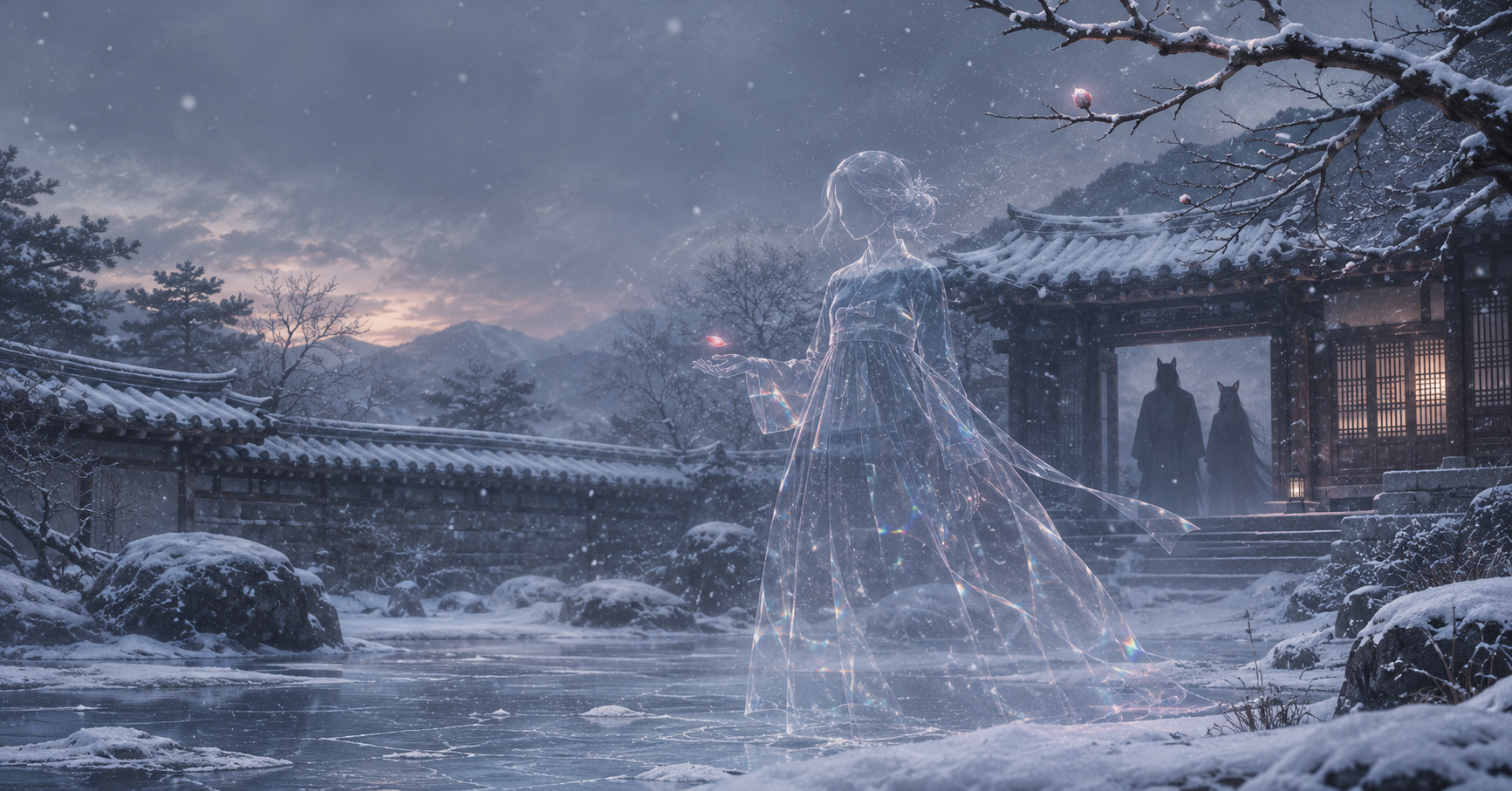
The girl born a mutant was called Hyang. She was born transparent: more transparent than a spring in the deep of the mountains, so clear that rain and snow fell around her without a sound, as if out of courtesy. When the sun was strong, small rainbows trembled for a moment on the spot where she stood, like the rumor of a presence.
She was a woman no one could see. Drunks, from time to time, swore that they had seen her. Drunks will swear to anything.
When the maids carried her past, swaddled, a fine fragrance seeped through the gaps in the cloth. Whoever caught it, man or woman, never forgot it. The heart ached faintly, and for the whole day a fever of longing consumed them, a longing as sharp as hunger. The village bachelors loitered at her gate for another breath of it, like moths around a snuffed candle. On fine days a scent that could neither be described nor forgotten lingered faintly at the mouth of the village, stirred the hem of a skirt, turned a corner in the road, and summoned up the most beautiful woman in the world. The people talked about the scent, and in talking touched, at least, the hem of the paradise they had lost. To people who did not want to remember the past and could not dream of a future, who lived inside a winter that would not end, imagining that scent was the only longing they were permitted.
Her fame leapt to the skies. Yet not one person had actually seen her, and not one ever would. When she put on a garment, the garment turned as clear as she was and was seen no more. When jewels were hung on her, they dissolved into the same glass. As if they had never been. As the Peach Blossom Land of legend has never been anywhere.
That the daughter of a retired courtesan, begotten by a man of rank and then discarded, should have been born transparent was, in its way, a stroke of luck. A beauty that existed only as rumor could be confirmed only by gentlemen of high rank, with their clairvoyance and divine arts. Whoever bound himself to her would surely be some gentleman of the first consequence. So the people whispered, in delighted anticipation.
Hyang’s mother was Wolmae, a celebrated gisaeng of Namwon in the province of Jeolla. Gisaeng were, as a rule, half-demons, and ordinary men who looked on one even once were so bewitched that they squandered their fortunes. Only a person with the power of a great house could stand against one. When Minister Seong bought her a small house and installed her in it, Wolmae conceived a hunger for a child. It grieved her to waste such genes. She cultivated her power; she breathed the clean air; she imitated the neural-synchronization breath and went channeling the cosmos, all to bring forth a fine child. The labor bore fruit. One night she dreamed of a woman descending in a landing craft, trailing a blue plasma tail like a comet’s. The dream was astonishing; the child was more astonishing still. Transparent! How was one to go about telling the neighbors whether she was pretty? Surely, thought Wolmae, with the blood of a great house in her, there must be something good in there somewhere, seen or unseen.
“What scent do you mean, Madam?”
“The scent of spring is on this child.”
Wolmae answered the maid proudly. The maid tilted her head. Not strawberries, not sesame oil, but the scent of spring? She had never heard of such a scent. The name was a triumph. It set people’s imaginations aflame. Born in winter, yet scented with spring: her face must be as fresh as spring itself.
But in the very winter Chunhyang was born, Minister Seong ceased to visit Wolmae’s house, and from then on did not so much as acknowledge his daughter, which, in the circumstances, was perhaps the least of her invisibilities.
The bitter winter passed and the spring came round again, but Minister Seong did not. It was the Little Ice Age, and spring was spring only in name, bitter as the winter. Even so, when spring came, Wolmae sat on the veranda and stared, without noticing the hours, at the garden wall, where not one blossom had opened. But Hyang knew that what her mother was watching was not the wall. It was the gate.
Kissing each petal, I forgot, and the flower fell;
the name of the one who left sets with the spring.
Hyang resolved that, whatever happened, she would never be forgotten.
*
Hyang was fifteen the year the house of Yi Hallim, from Samcheong-dong in Hanyang, the quarter of the upper class, received a provincial posting. Passing through Gwacheon, Geumsan and other stations, his rank climbed straight up, until he finally seized the juiciest seat the central government had to offer: magistrate of Namwon, where he would keep the local notables in check. He was a Hanyang man, practically a direct descendant of the time immigrants, and the local notables were only collateral branches. When he beat them in a contest of divine powers, the eloquent scholars shut their mouths and the commoners became obedient without being told.
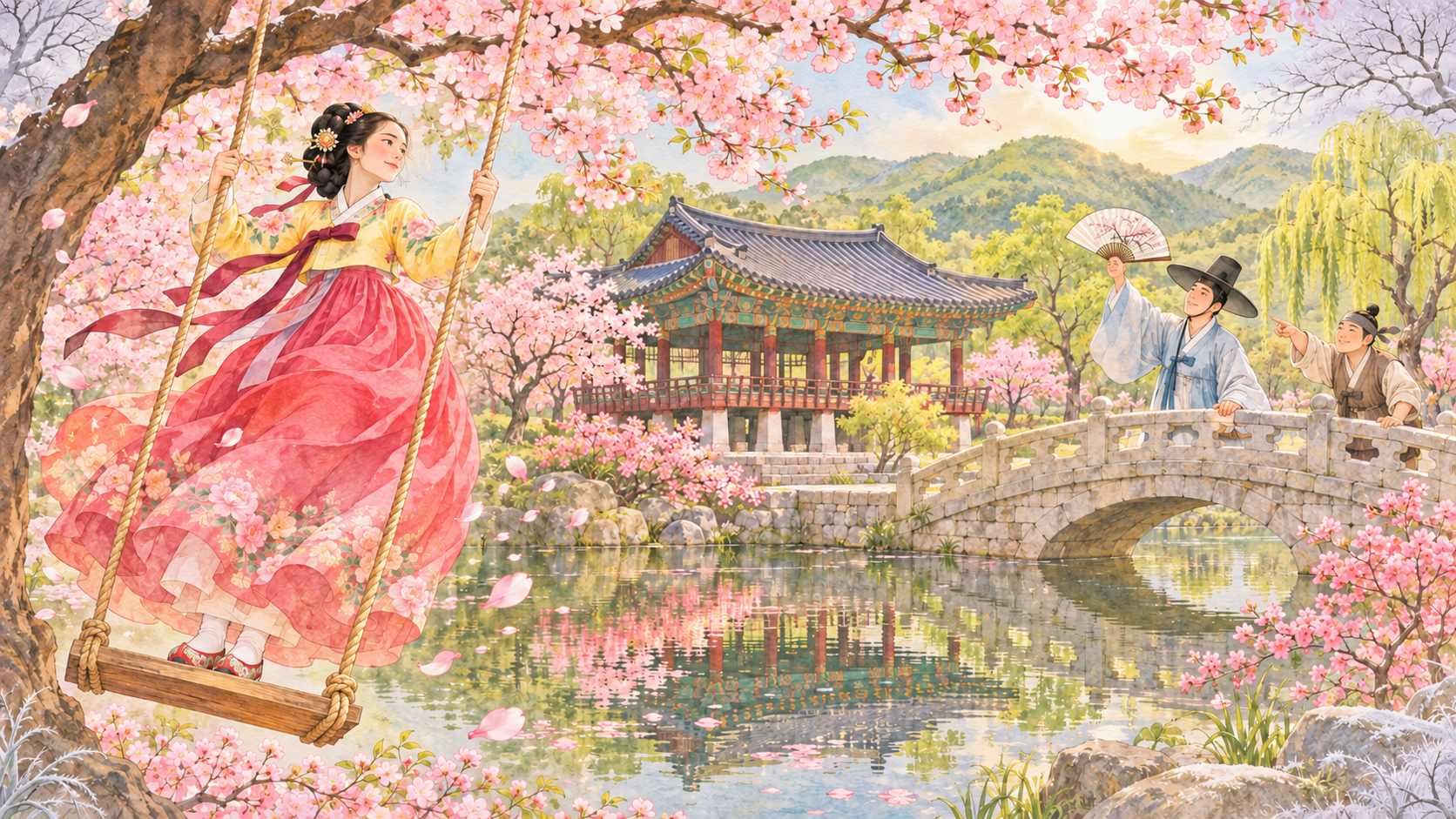
It was spring. The mating season, to be precise. There was no point in staging a protest against the absolute power of the Namwon notables, and the young were at leisure. Having heard that the Ojak Bridge at Gwanghallu was famous, Yi Hallim’s son, Young Master Yi Ryong, a man of fine bearing and ability, set out with his page, Bangja, walking ahead. Seeing a swing moving through the air, the curious Young Master gave an order.
“Go and see what that is, there, flitting and flickering, now here, now gone.”
“It is not a thing, sir. It is a person. Chunhyang, the daughter of the gisaeng Wolmae. Her mother is a gisaeng, but Chunhyang is proud and refuses a gisaeng’s work, and so cultivated that rumor says she is no different from a lady of a respectable house.”
“Splendid.”
“Can you see Chunhyang, sir?”
When the Young Master spoke, watching Hyang on her swing, her maid started out of her skin.
“You can see me, sir?”
Hyang reacted the same way.
“Of course. Yes, I see you. Spring came, my heart moved the wind, and I saw that.”
The Young Master had a way with airy, poetic remarks. Remarks no one could properly interpret, and which therefore could be interpreted any way one liked. They suited Hyang. Her own existence, too, was whatever people chose to make of it, and so something in his vagueness opened her heart. They moved from conversations of the heart to conversations of the body, and kept the relationship on good terms.
Word went around that she had at last chosen Ryong for a mate, and everyone nodded. Of course. Only someone of his caliber would do.
But a problem soon arose. The Young Master went to the capital to sit the civil service examination, sent no word, and did not return. One year. Two. As the years passed, the unease of those who had hoped for the romance of the century grew. And then, finally, something happened.
*
Byeon was from Namchon, the southern quarter. His fate had been cast far from the reach of power, and he had never married. No one would marry into the household of a fallen gentleman who needed support. He passed the examination at forty, obtained a post as a provincial magistrate, and lived a bland life. He was an ordinary man. The bloodlines of the time immigrants were different. With telekinesis, they peeked at the examiner’s intentions behind the questions. With divine arts, they summoned the successful answers of the past decade whole and copied them out overnight. Some seeped into the supervisor’s mind and planted the conviction that their own paper was “already excellent.” While the sons of ruined, ordinary gentry families recited the classics by lamplight, the time-immigrant bloodlines merely closed their eyes and drew on the abilities handed down from their ancestors, and that was enough. Passing the examination was decided not by ability but by blood. So any post above a magistrate’s was murky for him. Provincial magistrate was his limit. He would simply live out his life like this and go. He had no clever scheme, no great ambition. And if he had, it would not have been allowed.
Night at the government office was different from day. Torches flickered uneasily on the tiles under the dark. There was no moon. Byeon, pale of complexion, his lips oddly red, was reading a book with the door thrown wide open when he looked around. It was as if time had stopped. The rafters, the wall, the tall poplar tree were all still. Even the harsh winter wind held its breath. As if it expected something to happen.
There was an enormous noise. The sound of a door breaking and a chest flying through the air. But none of the servants or soldiers came to look. Then they appeared before Byeon’s eyes.
It was the local notable Scholar Kim and his slaves. The half-dead, half-alive ones were called brooms, and Scholar Kim brought them along from time to time. The brooms had eyes with no feeling in them. They approached as if to seize and swallow anything alive.
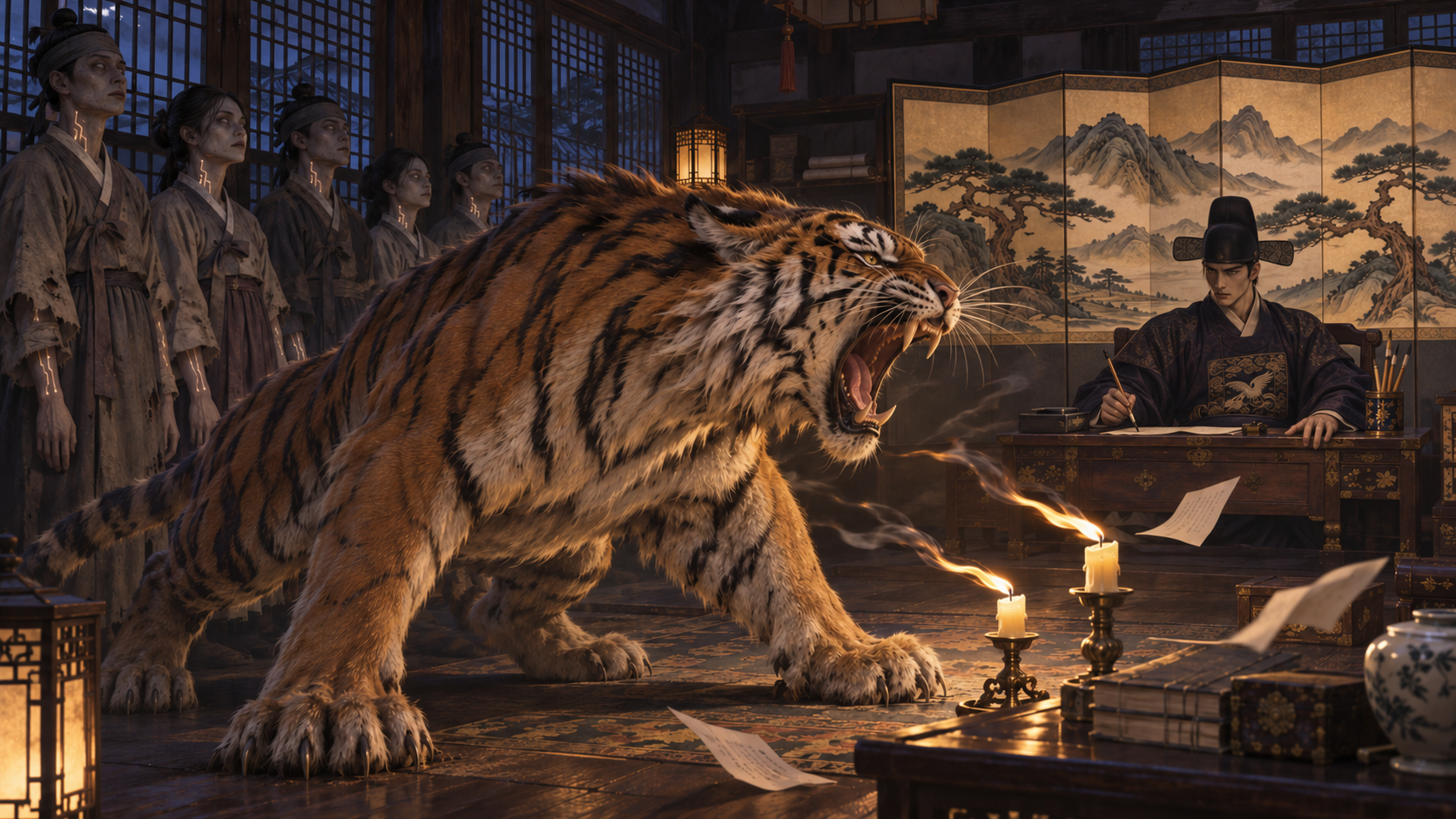
Byeon’s young servant, running in from somewhere, blocked them in his place. It lasted a moment. He was torn up and eaten.
Seeing this, Byeon’s expression did not change at all. With dignity, Byeon held out a hand to Scholar Kim. It meant: sit. Scholar Kim laughed loudly. Then light came out of his eyes. The brooms, whose gazes had been wandering everywhere, seemed to fix on the Scholar, and then, in distress, went to a corner and sat.
“Just as the rumors said.”
Byeon said.
“Here is my humble sincerity.”
The Scholar threw thirty thousand nyang down in front of him, in bundles of coins tied in many layers.
“We are helping each other.”
“My servant just died before my eyes. If this is sincerity, must I show you some of mine?”
Byeon pointed to the fallen servant.
“Is this how you send guests away?”
“No. A joke. I accept your sincerity gladly.”
Byeon’s hand trembled slightly with rage as he gathered up the coins. But he must not show it. Through all those years Byeon had earned no money, and the family property, kept by his sick mother at the ancestral home, had nearly bottomed out.
With a pleased smile, the Scholar stood. Sharp, shaggy nails showed at the ends of his jacket sleeves, and in an instant they raked down the desk and left a huge gouge. When Byeon raised his head, the Scholar had already turned into an enormous tiger and was bounding out of the room.
The local notables, in order not to let go of their privileges and to hide their corruption, quietly pressured those who came to take up posts at the government office. Byeon was not easily played, and the central government, valuing this, had sent him to Namwon. But it was the central government that had been played. Byeon formed deep ties with the local notables, thoroughly. He merely staged a show of deception between the court and the clans.
“Namwon is no easy place. Not only the tiger clan, but they also dig the dead out of their graves and use them. The dead, on whom even vampiric hypnosis does not work.”
The clerk said. The farther inland one went, away from the reach of the central government, the stronger the local great houses were. Far too strong.
Rank was fixed at birth, and dreams were fixed at birth. One’s own tastes were ignored. It did not matter. He had given up on the idea of changing anything the moment he was born.
For several days after taking up his post he amused himself, but there was nothing particularly new in it. Nothing new would ever happen in his life. Strangely, a deep sense of defeat was piling up in his heart.
“A woman who cannot be seen? What is that supposed to mean…?”
Byeon felt curious. He had assumed that surprising and wondrous things would not occur again for the rest of his life, and here, apparently, was one.
Only when he heard that the girl was Ryong’s mate did he understand the real reason. Yi Hallim’s son. In front of their divine powers, one could not so much as yawn aloud. One had to make oneself small.
Before the great clans, Byeon was nothing. In their eyes it did not even matter whether he existed. And if such a man could touch what one of the direct bloodline had claimed for himself. If he could bring one girl to her knees. At least for that moment, he would be someone who held something in his hand. A repayment for all the years of being trampled.
But Byeon heard that Hyang had refused him.
It did not matter. He received her intending to give her a few strokes of the paddle and send her home.
“That wench is supposed to smell of something uncanny?”
Byeon asked.
“Chrysanthemums, sir. Definitely.”
“No. It is the scent of a bamboo grove.”
He could not trust the people who described her scent. Byeon could smell nothing. He had been born with a condition that left him barely able to smell. A woman who bewitched people with scent? Byeon could not make sense of it.
“I will ask one more time. Will you attend me in my chambers?”
Byeon asked, but she did not answer.
“Do you truly mean to defy me?”
Byeon’s voice rose. Hyang still did not answer.
One stroke. Two. Three. He struck her with the paddle, and she did not utter a single scream. So much so that he ordered someone to feel the frame and check whether she was really lying on it.
The autumn sun shone brightly. Dying leaves fell one by one, pale, onto the flogging frame. The frame, made of wood in the shape of a cross, was old, and merely shabby.
She could be neither seen nor heard. As if she had never been. As if she would not be, even dead. Like himself, not worth a single gravestone, she was a person nobody noticed.
In this grotesque age, anyone became transparent before those who held power. So had Byeon. However loudly he shouted, he could not inflict so much as a scratch on the creatures. He was a pebble underfoot, kicked about and unnoticed. Kicked this way and that as a pebble, he had lost the sense of what it was to be alive. He had not even noticed that this was wrong. In that age it was natural for everyone to live like that.
Four. Five. Six.
Hyang’s scream rang in Byeon’s ear. The outcry that Byeon had let go, Hyang still had. She was alive. I am still alive. Byeon’s chest grew hot.
At the same time he hated her. He was angry at the thought that she was waiting for someone who would never return. Ryong would pass the examination easily, with his divine powers. So what? Did she think that meant he would come to save her? Foolish woman.
“Strike hard.”
The beating went on. He wanted to persuade Hyang. The name was wrong to begin with. Scent of spring? In a winter like this, in a season that went on and on. What spring was coming?
At last a faint voice came from her. Byeon rose from his seat and approached.
“What did you say?”
“I said I don’t want to.”
It was a quiet voice, but a proud one. The moment he heard it, Byeon felt an enormous rage. Her small, frail voice sounded like thunder to him. It was like something heaven was spitting at him. You are wrong. You cannot beat them. Neither you nor she can escape this fate.
The strokes multiplied. Byeon stood right beside her and listened to her screams. He meant to go on until his fury was spent.
“Say it again.”
Byeon asked, but now she had apparently fainted and could not answer.
“Say it again, I said.”
Byeon smiled a victorious smile. He meant to stop now.
Then something happened. As if in answer, he felt something like warm water spatter his face, but though he touched it, he could not see it. Something warm, with a raw smell. Her blood.
It was as if she had objected with blood instead of an answer. That hot, raw thing was crying out without a sound. I am here. I am alive.
It was then that Byeon, for the first time in his life, smelled the scent. A scent beyond description. The scent of blood. He rubbed the blood on his face with his hand and sniffed. He could smell it. A raw, sad scent. But lofty, pure, and fragrant. His heart began to pound. He felt alive. He did not know how long it had been. Was it when he had caught fish in the stream as a child?
Byeon sniffed his sleeve, but, as before, he could smell nothing else. The one thing he could be certain of was that this was a scent that could never come from himself.
Byeon, who had smelled nothing all his life, was thrilled to find that he could smell. The thrill grew. By day, a little torture let him catch the scent, but it only teased. By night, a strange longing for her grew fiercer. Joining bodies, joining words, might have settled the longing, it seemed, but she gave him no opening. For a whole month he sent her this and that, begged, threatened, tried to win her favor. It was no use.
Instead, the torture carried out by day grew more severe.
“You will kill someone like this.”
One day Wolmae shouted it, and collapsed.
“Strike harder.”
He kept saying it. She did not scream. Byeon was forced to understand something. It was not that she was invisible to him. He was invisible to her. Whatever he did, she neither looked at him nor spoke to him.
Being unseen by the creatures had never troubled him. Being unseen by Hyang was agony. So he struck more. He was in pain, and therefore she would have to be in pain too. That was the arithmetic.
Pain and the scent of blood were the only conversation the two of them had.
The people who had gathered to watch felt pity for her. For the first time, they felt that Chunhyang, uncanny powers or not, was in the end a human being like themselves.
*
“He wants Hyang brought out again. Had a cup of rice wine, I expect.”
People had begun to shudder at his conduct. Even the local gentry could no longer cover for him.
“Word is Ryong arrives tomorrow. Leave the girl alone. Otherwise I will have no choice but to punish you severely.”
Jinsa Kim gave him this last hint.
Hyang would go to Ryong now. That was certain. Byeon knew he must not let it happen, and he was losing the fight against himself.
“One last time I ask. Will you truly defy me?”
She answered him.
“I am waiting for my husband.”
That was the end of it.
Only then did Byeon seem to understand. What she was waiting for was not Ryong. It was a single phrase: I see you. When the whole world treated her as someone who did not exist, exactly one man had turned his head toward her. Perhaps what she was holding on to was not a man at all, but the only proof that she existed. For a person born transparent, that might be more desperate than love. It was nothing Byeon could give her.
His patience ran out. He could not bear to watch her go back to Ryong and complete that proof. If a fight could not be won, he knew exactly one method.
“Wrong. The one you should be waiting for is me.”
He drew a long sword. His hand shook. It was a different shaking from when he had brought down the paddle himself. The paddle had been a beating meant to keep her alive. The blade was its opposite.
“Wait for me in the next world.”
The blade opened her. She fell. No breathing, no scream. Nothing more could be heard.
*
Ryong walked toward Byeon, who knelt with his arms bound, one step at a time. He gave the impression of a man who saw no need to hurry.
“Kill me. It is murder.”
Byeon said.
“Why do you think Chunhyang is dead?”
Ryong’s tone was unhurried.
“You must have touched the body. The heart does not beat.”
“Odd. It seemed to be beating perfectly well.”
“What trick is this? Do you mean not even to hold a funeral?”
Byeon shouted.
Ryong bent and whispered in his ear.
“What is one more death? She was a person nobody could see to begin with. Hyang is mine. Forever.”
Only then did Byeon understand that Ryong could not see her either.
“I killed her. I killed Hyang.”
Byeon shouted.
But nobody would recognize Byeon’s crime of murder. Ryong had abandoned revenge in order to marry Hyang. After a trial of less than an hour, Byeon was dragged away, his hands tied behind him.
Ryong let it be known that he had built a separate villa in Hanyang with his own hands, and that Hyang lived there. It was said she did not attend the ancestral rites and did not eat, being, as everyone knew, an invisible person. Since Ryong could see her, her existence was accepted. When she was carried off in a flowered palanquin, the people standing nearby agreed that they had smelled something pleasant. For as long as Ryong lived, she was known as the most beautiful woman in the world.
Some decades went by, and the Little Ice Age ended. Spring grew warm again. Famines grew fewer. People found life more or less bearable. Once the hunger lifted, they raised their heads for the first time and took a proper look at the faces of those who had ruled over them.
The wolf clan did not notice that the eyes around them had changed. Neither did the nine-tailed foxes, nor the blood-drinkers. They had reigned for a hundred and some years, and nobody had ever taught them how to step down. The winter was over. They bared their teeth anyway, as they always had, and trampled people anyway, as they always had. This tyranny finished the job of uniting the people. While they starved, they had been too busy suspecting one another to band together. Fed, they found they could share the same anger.
Numbers were not the only reason the people won. The time immigrants were already collapsing from within. For over a hundred years the great clans had married only among themselves. They did not want to share power. But bind the same bloodline over itself for a century, and even the most careful design drifts out of true. At first, wondrous mutants were born, children who could light fires. Then, at some point, children began to be born who could use no power at all. The bodies they had brought from the future were no different. There was no one here who knew how to repair them, and no parts to repair them with. The circuits rotted. The techniques that had looked like sorcery stopped, one by one.
The people never learned that it had been science. To their eyes, Heaven was punishing the creatures and taking their divine powers away. Whether it had been divine power or science, the name did not matter. What people feared was not the name. It was the tyranny of the few who held it. What stayed in their minds was how many the monopoly of the few had starved, and how many it had turned into beasts.
When the central government recovered its strength, the great clans of the time immigrants were put to the sword, one after another. Byeon, too, was executed, from his minor post in the central government.
*
After Byeon’s mother died, he wandered the Eight Provinces without knowing why. Some decades later he passed through a village in Hanyang where Ryong had lived, and asked after Hyang. Nobody knew where she was.
Ryong had died suddenly, and there was no means of confirming whether Hyang was alive or dead. There were only rumors that a pleasant scent came from Ryong’s grave. A story spread through Ryong’s family that she had taken her own life before his grave, and it was said that a monument to a virtuous woman ought to be raised. The matter fizzled out. Nobody had ever found her body.
Byeon found out where Ryong’s grave was. He was shabby, with soot on his face. He washed in a nearby stream, straightened his clothes, and went to the grave.
Beside Ryong’s grave stood Chunhyang’s. The headstone did not give her name. It read: Wife of Yi Mongryong. The grave was neat and well kept. Byeon stroked the earth once with his hand. He had no way of knowing whether she was really buried there. He looked at it for a while, lay down in front of it, and fell asleep. He was very tired.
Half a day later he woke and caught, faintly, a scent. It was the one he remembered.
He understood then. The scent of Chunhyang’s blood was the spring of a life when the plants are green. The scent of flowers that bloom in spring, of birds pairing off, of trees coming back to life and the world growing warm. Decades ago, when he was young, it had been a raw, faintly sad scent of blood.
But he knew. What she had shed was always the blood of pain. And he, who found beauty even in that pain, was still stealing something from her, even in death.
“I don’t want to.”
It was the one sentence of hers that could only be got by torturing her. She had refused Byeon’s life, and she had refused Byeon. If that spring-like temper of hers was something he had loved, then he had loved it. Byeon wept without meaning to. He saw, only now, his own smallness: that he had tried to possess a person even if he had to kill her.
Sometimes he fell to thinking. If the winter had not been a harsh age that lasted for decades. If it had been a mild era. If the creatures who hid their teeth behind the excuse of the times had not climbed onto the throne. Then neither he nor Hyang would have grown this grotesque. Byeon would not have needed to torment others in order to feel alive in his powerlessness. She would have been able to give love and receive it. Only an ordinary love. The kind where, instead of blood spattering, laughter and teasing and the occasional fine verse passed between two people, and bodies joined in warmth. Not a grotesque love.
The age had made them grotesque. He knew that this was no excuse.
To honor that age was only to forget that age.
At every crossroads on his way, Byeon dropped a story among the people. At inns, at washing places, even in front of pansori singers. He told of a beautiful courtesan’s daughter in Namwon, and of a righteous young master who risked his life to protect her. He told, too, of a wicked magistrate who had beaten her out of envy of that love. When people asked the magistrate’s name, he gave them his own.
When he died, no one would know of his grotesque love. All he could do was make her the most beautiful and the most beloved woman there had ever been. If the price was that he stayed forever the vilest of villains, it no longer mattered to him. It was the last apology he had to offer her.
He turned his steps toward a faraway place. A very faraway place. A place where her scent would not reach his shabby end.
A few years after Byeon left, even the rumor of a scent from the grave died down. When the grotesque winter was over and bellies were full, people erased the past with great speed. How savagely they had torn at one another, how the creatures’ divine powers had set: nobody wished to remember.
What remained was a story. A love story of the lovely, beloved Chunhyang and the most righteous man in the world, Ryong. And the story of the villainous Byeon, who envied that love. It was not the truth, but nobody was curious. People had decided to remember those decades of winter as a single beautiful love story. It was much easier to bear.
This age had been only one of the several periods the time immigrants had chosen to emigrate to. The next age came some hundreds of years after Byeon’s death. This time it was not freezing but melting. Glaciers melted and the seas rose, and starving people crossed borders in droves, and the systems of many nations could not bear the weight and gave way one by one. It was an age in which saving a machine became more natural than saving a person. And so another good season began for those who hid sharp teeth to climb onto the throne.
Unauthorized reproduction or redistribution is prohibited. Sharing is welcome. © YK Yoon


답글 남기기